Overview
Open a cafe. One kid cooks and serves, another orders and pays with pebble money, and they swap roles. This is the most social mud-kitchen scenario: turn-taking, taking orders, handling pretend money, and back-and-forth conversation drive the whole thing. With two or more kids it runs an hour easily, and it pulls in language and early numeracy along the way.
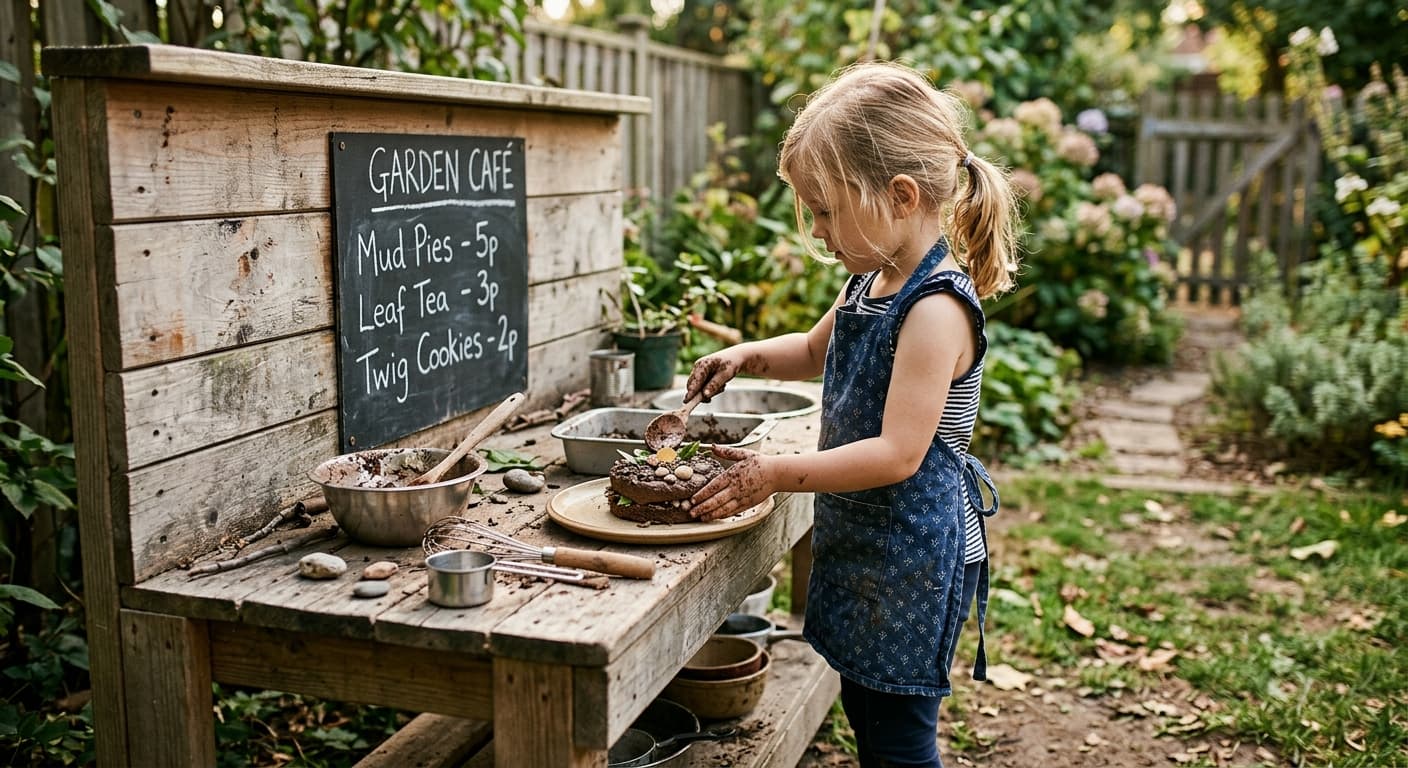
How to Do It
Set a small table beside the kitchen as the shop counter. Write a short menu on the chalkboard with prices ("mud cake, 2 pebbles; flower soup, 3 stones"). Gather a pile of pebbles or acorns as currency and set out plates, cups, and a serving tray.

Assign the first roles, chef and customer, and let the scenario run. The customer reads the menu, orders, and pays; the chef cooks the dish from mud and loose parts and serves it. The real work is the exchange: greeting, taking the order, counting out the right payment, making change. Swap roles every few orders so both kids get the cooking and the counting.
You can play the demanding customer to stretch it: "Two cakes and a soup, please, and how much is that altogether?" Then let them run the cafe without you.
Tips & Tricks
Pebble currency does the heavy lifting. Counting out "3 stones" for a 3-stone soup is addition kids do happily because they are playing shop, not doing math.
A real order pad (paper and a pencil) turns the chef into a waiter and adds a writing or mark-making step. Pre-writers scribble; that still counts.
Rotate who is boss of the cafe. Letting the younger sibling take orders while the older one cooks keeps both invested and heads off the "I always have to be the customer" complaint.
Variations
Easier (ages 3–4): Drop the money. Just take orders and serve. The turn-taking of "what would you like?" and "here you go" is plenty at this age.
Harder (ages 6–9): Run a real economy. Give each kid 10 pebbles to start, set prices, and see who has the most at the end. Add a daily special and a sign to advertise it. Introduce simple change-making: pay 5 pebbles for a 3-pebble item and get 2 back.
Family service: Have them take real orders from parents and grandparents and "serve" the whole family. An audience extends the play and gives them an authentic reason to get the order right.